


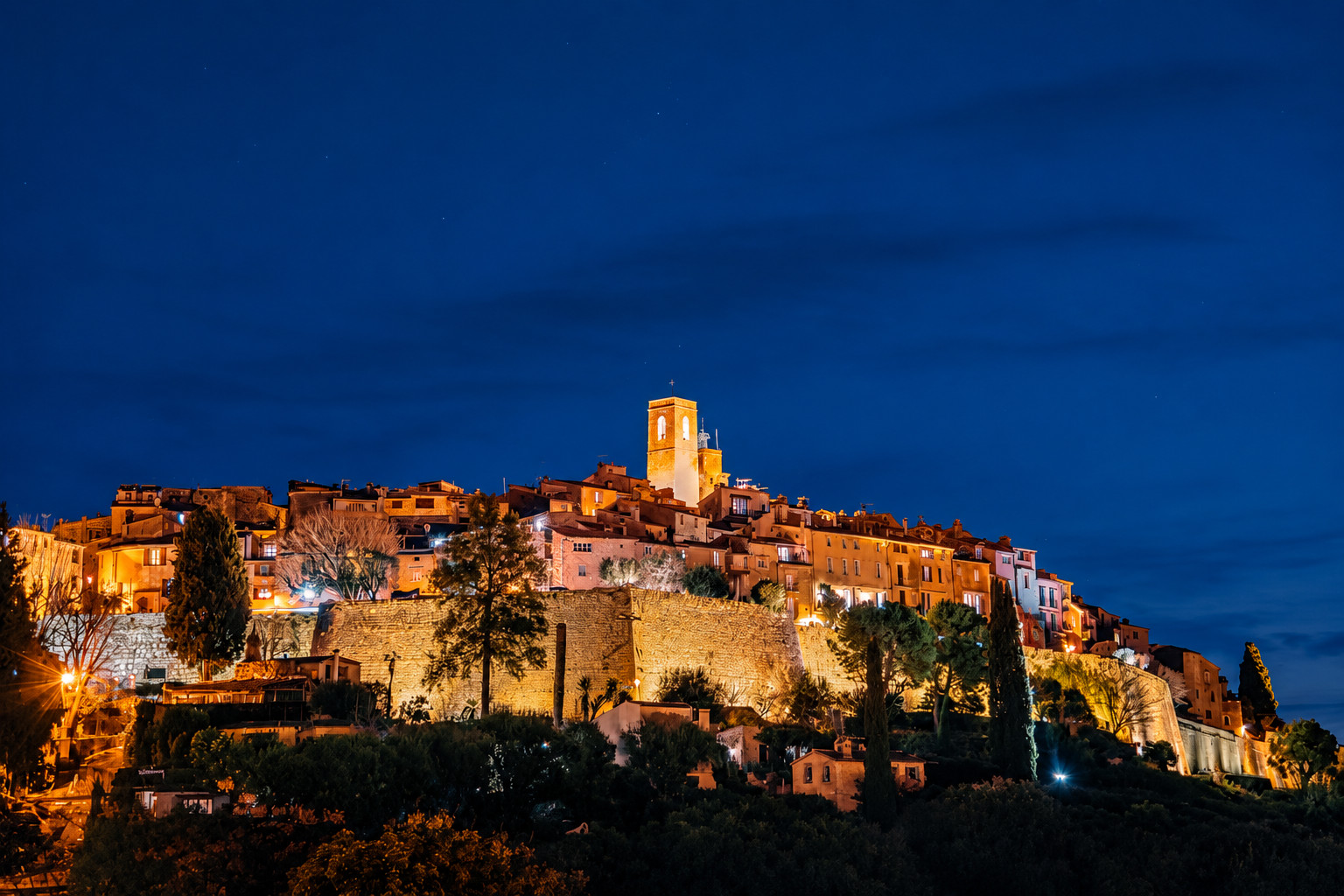
Saint-Paul-de-Vence and the Fondation Maeght: modern art 15 kilometres from Hôtel du Clos
Some villages you pass through, and some you inhabit for a day. Saint-Paul-de-Vence belongs to the second kind — provided you arrive early, take the side streets away from the main flow of visitors, and have a room nearby so you don’t have to watch the clock.
Fifteen kilometres from Le Rouret, perched between the inland hills and the sea you can just make out in the distance, the village concentrates in a few hectares what the Côte d’Azur has produced of lasting value in its relationship with art: an intact medieval core, an exceptional private foundation, galleries that have been open for decades, and a dining table around which Picasso, Matisse and Prévert once settled their bills in paintings.
A village built alongside its artists
The ramparts of Saint-Paul-de-Vence date from the sixteenth century — François I had them built to defend the border with Savoy. They are what preserved the village from expansion, keeping it within its original proportions: one main street, perpendicular lanes, plane-shaded squares, and walls you can walk in twenty minutes with an open view across the hills.
The artists came in the 1920s, drawn by the light and the low cost of living. They stayed at La Colombe d’Or, an inn that has become, over the decades, one of the most singular places in France: its walls are covered with works by Braque, Léger, Miró, Calder and Picasso — given in exchange for meals and nights at a time when those names were not yet worth much. The collection you can admire over lunch or a drink in the courtyard is today worth tens of millions of euros, and no owner has ever thought of moving it.
The Fondation Maeght: sixty years of art in stone and gardens
Founded in 1964 by Aimé and Marguerite Maeght, the Fondation Maeght is the first private foundation dedicated to modern art in France. The architect Josep Lluís Sert designed the buildings in collaboration with the artists themselves: every space was conceived in dialogue with a specific work.
The result is a place that resembles no other museum. You don’t enter white, silent rooms — you move between structures of pink brick and pale concrete, cross the Giacometti Courtyard where bronze figures seem to walk across the lawn, step into the Miró Labyrinth where sculptures, ceramics and fountains speak to one another in Mediterranean vegetation, and pause before the Braque stained glass and Chagall mosaics set directly into the walls.
The permanent collection holds more than 13,000 works — paintings, sculptures, prints, ceramics — by Miró, Giacometti, Calder, Chagall, Braque, Léger, Kandinsky and dozens of others. Only part of it is on display at any one time, rotated around the temporary exhibitions.
Opening hours: daily 10am – 6pm, until 7pm in July and August
Admission: €18 / €14 (concessions) / free for under-16s
Through the lanes: galleries, the Fondation CAB and quiet terraces
Beyond the Fondation Maeght, the village itself works as an informal art trail. Around forty galleries occupy the ground floors of medieval houses — some established for more than thirty years, others more recent, all open without appointment. Quality varies; the pleasure of wandering does not.
The Fondation CAB (Contemporary Art Beliefs), housed in an old bastide at the entrance to the village, presents a programme of more recent contemporary art with regularly renewed temporary exhibitions. Its sculpture garden alone is worth the detour.
For lunch or a mid-morning drink, the Place de la Grande Fontaine offers a few tables in the shade, away from the busier restaurants on the main street.
On now: the Ellsworth Kelly exhibition
Until 15 November 2026, the Fondation Maeght is showing At the Edge of Water, an exhibition devoted to Ellsworth Kelly’s work through the lens of water. A rare opportunity to set the permanent collection alongside a thematic reading of one of the great names in twentieth-century American art — an artist who, it is worth noting, stayed repeatedly with the Maeght family here in Saint-Paul-de-Vence.
If you are planning a visit this autumn, September and October are the best months: the extended summer hours still apply in September, the quality of light in the hinterland at this time of year is exceptional, and the queues have gone with the summer crowds.
→ Read our dedicated article on the Ellsworth Kelly exhibition
Hôtel du Clos, 15 minutes away — to take the time the place deserves
Saint-Paul-de-Vence does not lend itself to a quick visit. The Fondation Maeght deserves two unhurried hours. The galleries reward a return. La Colombe d’Or earns its place at the aperitif hour, when the tour groups have moved on.
From Hôtel du Clos, in Le Rouret, you are fifteen minutes away. You can arrive at opening time, leave for lunch, come back in late afternoon when the light changes on the ramparts. Or spend two days exploring the surrounding area: Gourdon fourteen kilometres away, Grasse nine, Vence twenty — each village within easy reach, without having to choose.
Book directly on our website — no intermediary — and benefit from our direct booking rates.
→ Check availability
Saint-Paul-de-Vence is one of the destinations we most readily suggest to our guests as a starting point for the hinterland. For other ideas for excursions from Le Rouret — Gourdon, the Gorges du Loup, the Grasse market — feel free to ask us during your stay.